By Laura Gardner, Master Gardener
That White Stuff has a Function
When a deciduous tree or shrub doesn’t have its foliage, other parts of the plant such as the stems and branches are more noticeable. For example, some species like this Manitoba Maple (Acer negundo) have a noticeable waxy cuticle or bloom on its young stems. This coating or layer acts as a defense mechanism that protects the plant from moisture loss, ultraviolet radiation, dust, fungi, pathogens, and insects. Concerning the latter, researchers found that a certain beetle species could temporarily lose its grip after its “tarsal setae” was covered with the wax stem crystals from A. negundo.[i] Research has also shown that A. negundo is able to regenerate the wax within only a few hours after its removal.[ii]

Waxy Cuticle of a Young Manitoba Maple (Acer negundo)
Dandelions in February?
I don’t remember the last time I saw a Dandelion (Taraxacum officinale) in my garden bloom so early in the year. Coltsfoot (Tussilago farfara) are usually the first yellow flowered plants to appear, but this one is clearly a Dandelion. From what I’ve read, it isn’t all that unusual. A researcher at the University of Western observed that “if there is a January or February thaw that lasts for at least a week, then flowering and seed production can occur.”[iii] This week’s mild temperatures caused the snow to recede by my walkway, unveiling a yellow bloom. It may be considered a “day-neutral” plant, but some also view it as a “short-day” species. “Day-neutral” species do not require a specific photoperiod to flower and “short-day” species flower with day lengths less than 12 hours.[iv] Its non-dormant seeds are also able to germinate at temperatures as low as 5 degrees Celsius.[v] In winter, they lie close to the ground as a basal rosette with the crown drawn towards the ground for maximum protection from the elements.[vi] More developed plants will have large energy stores in their tap roots to fuel more vegetative and flower growth in the spring.

Closeup of Dandelion
No Fall Cleanup
Last summer I planted a mass of Annual Sunflowers (Helianthus annus). Ideally, the dead plants would have been left completely intact in the fall to overwinter, but the flower/seed heads were so heavy that the stems had broken under the weight. I cut the pithy stems and seed heads and left them in a pile nearby for wildlife. The chipmunks were quite appreciative. Come spring, the old stems will remain for stem nesting bees such as Megachillidae species (e.g. Small Mason Bees and Leaf-Cutter Bees). Approximately 30% of our native bees require above-ground nesting sites. Rather than including commercial “bee hotels” in my garden, I am aiming for a constant cycle of old and new plant stems. New sunflowers will be planted around the old stems to eventually become new nest sites. Providing a wide range of different sized hollow and pithy-stemmed plants will also attract a variety of different bees. Some hollow-stemmed species in my garden include Milkweed (Asclepias), Bee Balm (Monarda), Cup Plant (Silphium), Anise Hyssop (Agastache), and Joe Pye Weed (Eutrochium). Some pithy-stemmed species include Ironweed (Vernonia), Aster (Symphyotrichum), Goldenrod (Solidago), and Coneflower (Echinacea).[vii]

An Arrangement of Dead Plant Stems for Nesting Bees
A Dying Maple
Last summer, I noticed that a Norway Maple (Acer platanoides) tree in my front yard was showing dieback of the canopy in the centre. I can only guess, but I suspect that root girdling was the main cause. Environmental stresses such as drought and road salt could only have compounded the situation. Another strike against this tree is that it has weak co-dominant stems. I contacted the city to have them check it out. I came home to see the dreaded pink spot spray-painted on the trunk—it is marked to come down. I feel mixed emotions—on one hand, it is an invasive species that isn’t the best for our ecosystem but on the other hand, it is still sad to see any living tree come down—especially one that wasn’t very old. If it could remain safely standing as a snag, that would be beneficial for wildlife. A snag is a dead tree that is left to breakdown naturally. It serves as a nesting site for birds and other wildlife and the insects that reside in them serve as food for wildlife, fungi, and other microorganisms.
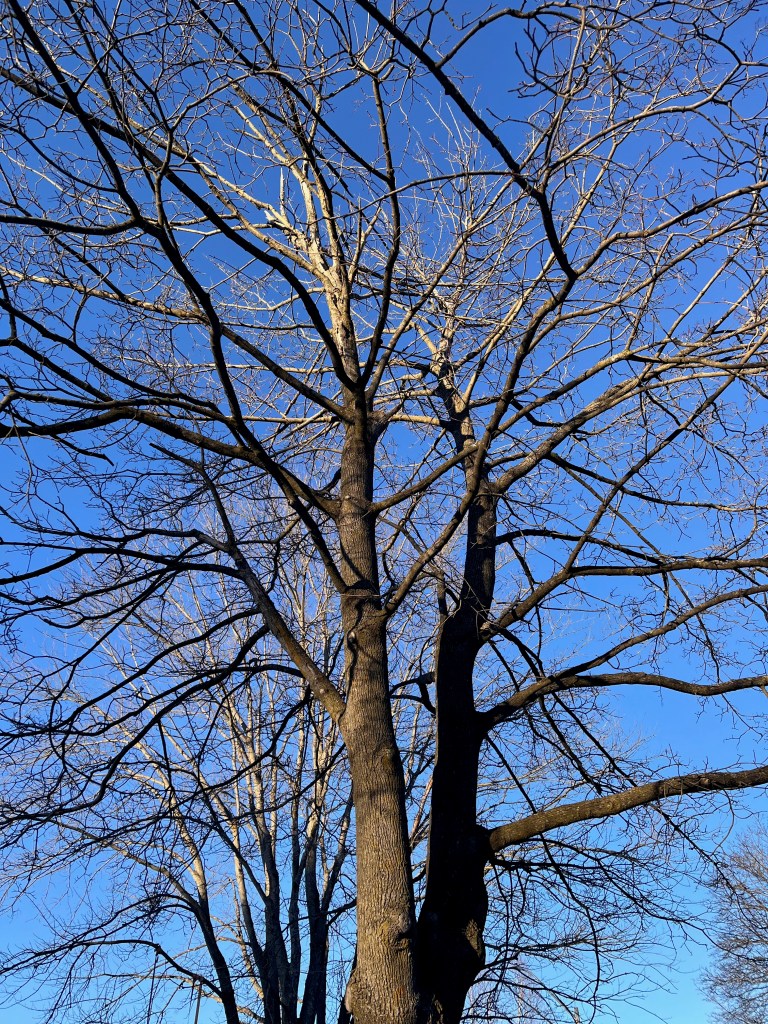
A Dying Maple

A Neighbour’s Snag
What’s going on in your garden?
[i] Gorb, E.V. and Gorb, S.N. (2002), Attachment ability of the beetle Chrysolina fastuosa on various plant surfaces. Entomologia Experimentalis et Applicata, 105: 13-28. https://doi.org/10.1046/j.1570-7458.2002.01028.x
[ii] Tomaszewski, Dominik & Zieliński, Jerzy. (2014). Sequences of epicuticular wax structures along stems in four selected tree species. Biodiversity: Research and Conservation. 35. 9-14. 10.2478/biorc-2014-0014.
[iii] S. M. Stewart-Wade, S. Neumann, L. L. Collins, and G. J. Boland. 2002. The biology of Canadian weeds. 117. Taraxacum officinale G. H. Weber ex Wiggers. Canadian Journal of Plant Science. 82(4). p. 835. https://doi.org/10.4141/P01-010
[iv] Ibid.
[v] Ibid., p.837.
[vi] Ibid., p. 832.
[vii] Roos, Debbie. Provide Nesting Habitat for Native Bees Through Plant Stems in Your Garden. NC State Extension. Online: go.ncsu.edu/readext?857307
 The Peterborough & Area Master Gardeners
Great article! Yes, losing a tree, no matter what variety is sad.
LikeLike