By Thom Luloff, Master Gardener in Training
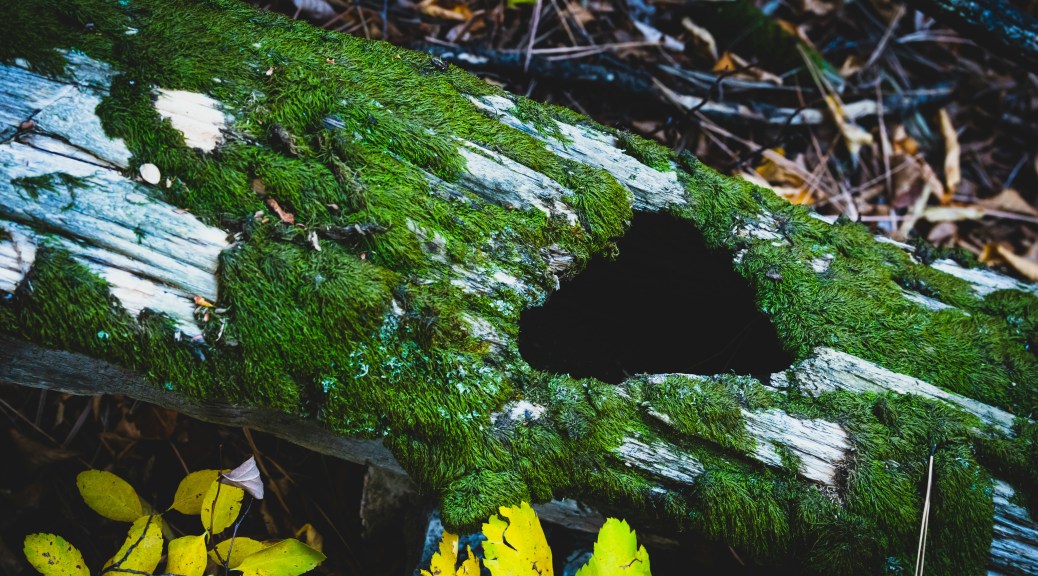
In the quiet corner of your garden, a story unfolds—one of decay, renewal, and survival. A fallen log, at least 15 cm in diameter, lies undisturbed, its bark peeling away with time. To most, it might seem like nothing more than a lump of rotting wood, but to the creatures of Ontario’s forests and backyards, it is a shelter, a buffet, and a nursery all in one.
The Architects of Decay
The transformation begins with Turkey Tail (Trametes versicolor), a vibrant bracket fungus spreading across the log in waves of blue, green, and brown. Working quietly, it releases enzymes that break down lignin, the tough compound that gives wood its strength (Boddy et al., 2021). Alongside it, Hairy Curtain Crust (Stereum hirsutum) and Split Gill Fungus (Schizophyllum commune) creep across the wood, softening its once-solid structure and preparing it for the next wave of life.

The Engineers of the Wood
As the fungi work their magic, the log becomes an inviting home for insects. Snails and slugs slither across its damp surface, feeding on the growing fungi. Beneath the bark, Carpenter Ants (Camponotus pennsylvanicus) carve out intricate tunnels, not to eat the wood but to create hidden chambers for their colony (Foelix, 2019). Their tunneling allows moisture and air to penetrate deeper into the log, making it an even richer habitat for the next arrivals—Ontario’s native beetles.
Black ground beetles of various species arrive on the log en masse, searching for a place to lay eggs. Their larvae burrow deep into the softened wood, slowly turning it into nutrient-rich humus (Harvey et al., 2011). These beetles, in turn, attract predators like the Six-Spotted Tiger Beetle (Cicindela sexguttata), a metallic green hunter patrolling the log for an easy meal.

A Shelter for Ontario’s Wildlife
As the log softens and cracks, it becomes a refuge. The Eastern Red-backed Salamander (Plethodon cinereus) slithers beneath it, hiding from the drying heat of the day. This moisture-loving amphibian thrives in the humid microclimate the log provides, emerging at night to hunt for small insects. Nearby, the Northern Short-tailed Shrew (Blarina brevicauda) scurries through the leaf litter, using the decaying log as a hiding spot between hunting trips.

Above, the White-throated Sparrow (Zonotrichia albicollis) scratches at the log’s surface, searching for insect larvae hiding within. Not far away, the American Toad (Anaxyrus americanus) tucks itself into a crevice, waiting for dusk to begin its nightly hunt. Even the Little Brown Bat (Myotis lucifugus), a species at risk in Ontario, may roost in the log’s hollowed-out cavities, using it as a safe shelter from predators.

A Final Gift to the Soil
As the years pass, the log continues to break down, its nutrients seeping into the soil. Studies have shown that decomposing wood increases soil fertility and microbial diversity, providing essential nourishment for plants and fungi alike (Harmon et al., 2020). What was once a towering tree now gives back to the very land it grew from, ensuring the cycle of life continues.
Leaving a log to decompose in your garden isn’t just an act of neglect— it’s an act of conservation. It creates a thriving ecosystem, supporting species often overlooked in urban spaces. So the next time you see a fallen branch or an aging log, resist the urge to clean it up. Instead, leave it where it lies and witness the hidden world of life it supports.
References
Boddy, L., Hiscox, J., & Gilmartin, E. (2021). Fungal decomposition of wood: Fundamentals and impact on ecosystems. Annual Review of Ecology, Evolution, and Systematics, 52(1), 121-142.
Foelix, R. (2019). Biology of Spiders. Oxford University Press. Harvey, D. J., Hawes, C. J., & Gange, A. C. (2011). The role of dead wood in maintaining beetle diversity. Biodiversity and Conservation, 20(10), 2307-2323.
Harmon, M. E., Fasth, B., Woodall, C. W., & Sexton, J. (2020). Carbon storage and nutrient cycling in decomposing logs: A long-term perspective. Forest Ecology and Management, 466, 118127.
 The Peterborough & Area Master Gardeners