By Carol Anderson, Master Gardener in Training
Whether you have found yourself in a small space with limited capacity for planting garden beds or enjoy the opportunity to be creative, container planting can brighten any spot in the garden. Containers add dimension, interest and instant colour to a patio, deck, or garden. Containers can be grouped together at different heights and can be used alone in the garden to add height and/or colour in an area where this is needed. Container gardening, however, is both a science and an art. Understanding and providing the right conditions (e.g. light, moisture and nutrition) for your plants is just as important as building an esthetically appealing container garden that can be enjoyed throughout the season. Understanding the basics will go a long way to ensuring a season of enjoyment and success.
Considerations to factor in:
- What kind of conditions are present (e.g. How much sunlight and what time of day? Is there significant radiant heat from concrete/pavement, etc.? Is there protection from the afternoon summer heat?) Once this is understood, then plants which thrive in the same conditions can be grouped together.


Figure 1. Plants in this area must be heat and drought tolerant
Figure 2. Any container or group of containers will do!
Figure 3. Monochromatic shade. Container can be calming.
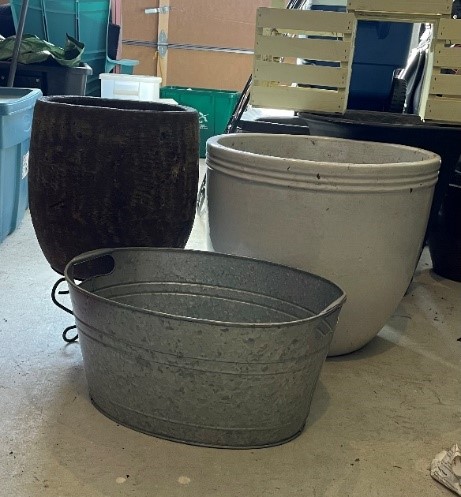
- What type of containers you should use depends a great deal on the local conditions and the effect you are trying to create (e.g. formal or rustic, etc.). While terracotta pots can be pleasing to the eye, they dry out faster than glazed or fiberglass pots, requiring more frequent watering. Keep in mind, any container that holds soil can be used as a planter if drainage holes are made in the bottom. Always select planter soil that meets the requirements of the plants and conditions; usually one with peat, perlite and organic matter.
- What kind of effect am I trying to create? Opposite colours (like orange and purple) create drama and excitement, while corresponding colours create calm and harmony. A “punch” of white will catch the eye…something that can be stunning in a shade container.
- Consider the basic design principles of colour, texture, and shape. As with colour, texture can be used to create visual interest to a space. Fine texture of a leaf or flower can feel whimsical, and often needs to be observed up close. Large coarse textured leaves with contrasting venation can create a bold impact observed from a distance.
- And finally shape. Consider constructing your container with 3 types of plants: Thrillers, fillers, and spillers. Plant your tallest plant first (and consider vantage point), then add your feature plant (thriller), then add some filler plants and lastly the trailing variety which spill out of the container. Or…consider a single plant in a container as a feature.
Remember that whatever you choose to do, the combinations of plants are endless. Large tropicals, perennials and annuals all have their place in containers. Some can be brought indoors at the end of the season to winter inside, some can be placed into the garden bed directly, and unfortunately some will only have one season in your garden. Regardless, experiment and take lots of notes so that the following year you can recreate an impact that you enjoyed or change up a container that didn’t have the effect you desired…


Figure 4. Use of tropical Elephant Ear (Colocasia) adding a bold impact.
Figure 5. Monochromatic shade plants with similar leaf shape.
Figure 6. Large leaf perennial with texture (Siberian bugloss) adds drama.


 The Peterborough & Area Master Gardeners