
By Laura Gardner, Master Gardener
Have you ever wondered how certain insects are able to discover a plant in your garden? How do they know it is there? Some of them may already have been hanging out there but others fly in from afar. How does a predatory insect seem to find its prey without much effort? Both insects and plants engage in the production and release of chemicals such as pheromones and allelochemicals. These can act as insect attractants and deterrents.
Last year I grew Tomatillos. I usually grow Tomatoes but I thought I would try Tomatillos instead. One of my plants was visited by Three-Lined Potato Beetles (Lema daturaphila). These insects feed on plants in the Solanaceae family such as Tomato, Potato, Eggplant, Tomatillo, and Groundcherry. From my reading, this species is not very damaging so I was willing to monitor and see if beneficial insects would step in to act as biological control agents. Sure enough, soon afterwards, when I was inspecting my plants, I found an assassin bug eating the beetle larva that were under a leaf. Just like Lily Leaf Beetle (Lilioceris lilii) larvae, the Three-Lined Potato Beetle larvae cover their backs with their own excrement called a “fecal shield,” as a means of defence. Clearly the assassin bug was undeterred. Plant volatiles had likely been released by the plant in response to the larvae feeding damage to the leaves. This has been described as an indirect defence mechanism[i].” The assassin bug responded as it detected the plant volatiles.
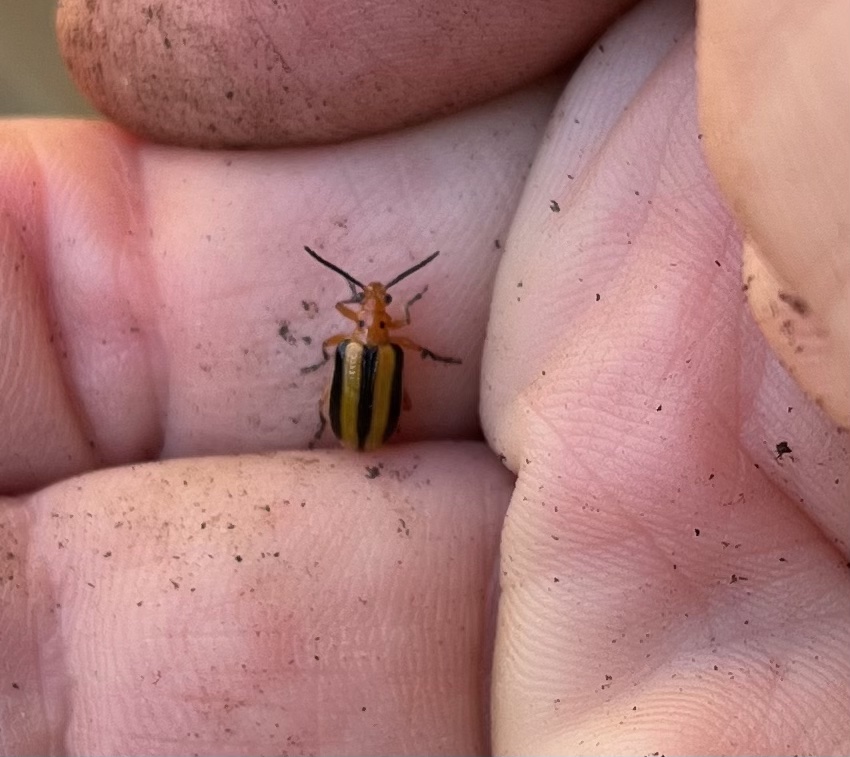
This spring, I planted some cantaloupe and watermelon seedlings in a raised bed. I read up on the various insects that are attracted to these plants—their life cycles and behaviours. One of the insects that favours cantaloupe and other members of the cucurbit family is the Striped Cucumber Beetle (Acalymma vittatum). Up until recently, I hadn’t seen any on my plants. Often, I will use floating row covers for protection from insect damage but these plants are currently flowering so they are uncovered so pollinators can access them. When I saw my first beetle, I thought about how it knew I was growing cantaloupe. Cucurbit plants emit floral volatiles in the air that travel. Adult cucumber beetles are attracted because the pollen of the plants makes up a part of their diet.[ii] These same and other volatiles also attract pollinators of these plants such as Squash Bees (Eucerini spp.).[iii]
Cucurbit plants also contain a chemical called cucurbitacin. This is the substance that gives some cucurbits a bitter taste. When cucumber beetles feed on the leaves and other parts of the plant, they absorb the cucurbitacin, rendering them unpalatable to many predators. Young plants produce more cucurbitacin than older plants—which make them more attractive and vulnerable to damage.[iv] Cucurbitacin is so attractive to the beetles that it encourages more and more feeding—called a “phagostimulant.”[v] (Is this the same as sugar, salt, and fat for us humans?) As the beetle feeding progresses, adult male beetles give off an aggregation pheromone called vittalactone that invites others to come and join the party.[vi] Cucurbitacin also plays a role in their reproductive activities as males transfer it to the females as “nuptial gifts.”[vii]
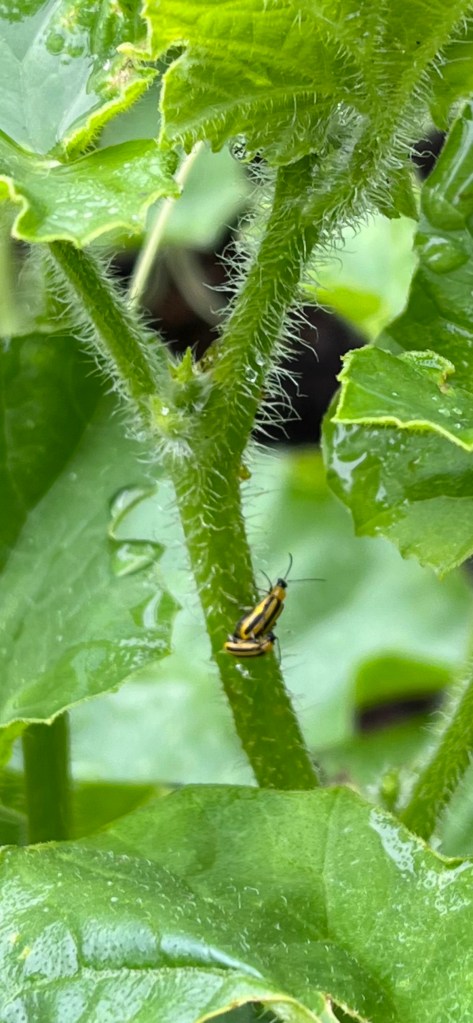
The beetles can also transmit bacteria via their feeding that causes a fatal wilt in the plant. What is also unfortunate is that the wilting plant gives off more volatiles that attract more beetles. The flowers of wilting plants are not as attractive as non-wilting plants—this encourages the beetles to move on to other nearby plants, thus causing further spread of the disease.[viii]
In the end, the key is to try to deter adult beetle feeding as much as possible. This can be achieved in a number of ways such as using floating row covers; delaying planting in the spring; planting more developed transplants; hand-picking beetles in early evening when they are most active; planting cucurbit varieties with lower levels of cucurbitacin,[ix] interplanting plants like radishes and nasturtium with melons,[x] and using straw mulch around plants to attract beneficial wolf spider predators.[xi] Some cucurbits like watermelon are resistant to bacterial wilt,[xii] unlike cantaloupe. So perhaps by the end of the summer I will at least have watermelon.
[i] Dicke, M. (2009), Behavioural and community ecology of plants that cry for help. Plant, Cell & Environment, 32: 654-665. https://doi.org/10.1111/j.1365-3040.2008.01913.x
[ii] Rojas, Erika Saalau et al. Bacterial Wilt of Cucurbits: Resurrecting a Classic Pathosystem. Plant Disease 2015 99:5, p. 569. https://apsjournals.apsnet.org/doi/pdf/10.1094/PDIS-10-14-1068-FE
[iii] Andrews ES, Theis N, Adler LS. Pollinator and herbivore attraction to cucurbita floral volatiles. J Chem Ecol. 2007 Sep;33(9):1682-91. doi: 10.1007/s10886-007-9337-7. Epub 2007 Jul 21. PMID: 17659427.
[iv] Rojas, p. 569.
[v] Wallingford, Anna. What Cucumber Beetles Want. Over Informed on IPM. August 13, 2020, Episode 24. https://extension.unh.edu/blog/2020/08/over-informed-ipm-episode-025-what-cucumber-beetles-want
[vi] Ibid.
[vii] Rojas, p. 569.
[viii] Alexander, Lauren Maria. Take Control of Cucumber Beetles. Growing Produce. https://www.growingproduce.com/vegetables/take-control-of-cucumber-beetles/
[ix] Ibid.
[x] Cline, G. R., Sedlacek, J. D., Hillman, S. L., Parker, S. K., & Silvernail, A. F. (2008). Organic Management of Cucumber Beetles in Watermelon and Muskmelon Production, HortTechnology hortte, 18(3), p. 444. https://doi.org/10.21273/HORTTECH.18.3.436
[xi] Striped and Spotted Cucumber Beetle: Insect Pests of Vegetable Gardens. Kansas State Research and Extension. https://bookstore.ksre.ksu.edu/pubs/MF3545.pdf
[xii] Rojas, p. 565.
 The Peterborough & Area Master Gardeners