by Cheryl Harrison, Master Gardener
What is an invasive terrestrial plant?
Invasive terrestrial (grows on land) plants are non-native trees, shrubs, and herbaceous plants that are spread by global trade, humans and animals, and gardening. These plants have the ability to out-compete our native plants for space, nutrients and moisture. This means that they can damage the environment, human health and can have an economic impact.
Some also contaminate the soil so that it is difficult for other plants to grow even after the invasive has been removed (e.g. garlic mustard [Alliaria petiolate] – a herb).
Invasive plants may seem perfectly at home and under control in your garden. However, seeds can be relocated by an animal or other means. Other plant parts (e.g. rhizomes) can grow into new plants when you do a clean-up and dump your garden refuse in another perhaps wild area. This sets the invasive plant free!
Japanese Barberry
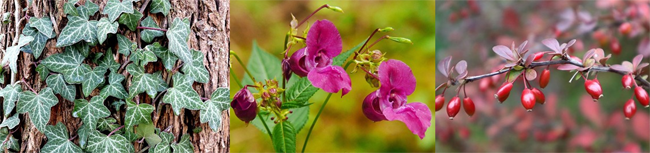
Japanese Barberry (Berberis thunbergii) is an invasive shrub which has green to dark reddish purple leaves. It has many small, densely growing twigs and branches that have spines. Its small flowers develop into red fruit which may be eaten then distributed by birds. It can grow 1-2 m (3-6 ft) tall in full sun to part shade and well drained soil.
I brought home two Japanese Barberry a few years ago. We had finished building our house and had started landscaping. At that time, I did not know that Japanese Barberry was a poor choice. They are not only invasive but also attract ticks.

Himalayan Balsam
Himalayan balsam (Impatiens glandulifera) is a striking, but invasive, plant that grows 1-3 m (3-10 ft) tall. It has a reddish stem and produces pink, white or purple flowers. Seed pods are produced which explode when mature. This helps to scatter the seeds. This plant not only out-competes other plants through its prolific seed production and its size, it also produces large amounts of nectar which attracts pollinators. The same pollinators which would normally be pollinating native plants.
This plant prefers a moister soil and grows well in sun or part shade. I have seen a massive area where this plant was growing near a residential location in a moist spot. A gardener showed it to me. She had been discarding her garden refuse in this spot for years. She had not realized that the Himalayan balsam, growing in her garden, was an invasive species until……

English Ivy
English ivy (Hedera helix) is an invasive evergreen (leaves are present and stay green all year round) vine. It can form a thick ground cover and a dense canopy in trees. It prevents other plants from growing and can, eventually, even kill a tree.
English ivy is also a reservoir for bacterial leaf scorch (Xylella fastidiosa). This bacterium infects a plant (e.g. many species of trees) and eventually blocks the xylem cells. Xylem cells are responsible for moving water and nutrients from the roots upwards into the plant. This disease will eventually kill the affected plant.
English ivy needs little light once established. I have seen this plant where it had overgrown an area. It was an ugly and truly disheartening spectacle.

You may come across any of these plants for sale in a garden centre, in a friend’s garden who wants to share, or one may have hitch-hiked with another plant into your own garden. They are some of the plant world’s thugs and can do a lot of damage.
Please be aware of all of Ontario’s invasive terrestrial plants…..yes there are more. Eradicate them and inform your garden centre if you see them for sale.
For more information:
Gardeners Action Plan – Government of Ontario
Invasive Terrestrial Plants – Government of Ontario Invading Species Awareness Program
Ontario Invasive Plant Council – list of invasive species and best management practices
When Ground Cover Plants Take Over – blog by Carol Anderson, Peterborough & Area Master Gardeners
 The Peterborough & Area Master Gardeners